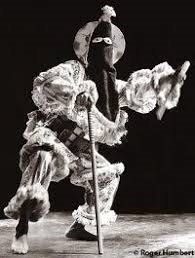
En Abakuá, el Ireme (también llamado Ñáñigo) es un bailarín enmascarado y figura espiritual que representa a los espíritus ancestrales y actúa como un ejecutor de justicia, protector de los secretos de la sociedad y purificador durante rituales e iniciaciones.
Vestido con un traje ajustado de cuerpo completo con una capucha de tela y una escoba o palo, el Ireme realiza danzas sagradas que son centrales en las ceremonias de Abakuá, encarnando tanto el misterio como la autoridad.
Palo
Palo
El Palo es una religión afrocubana con varias denominaciones que se desarrolló entre los esclavos centroafricanos y sus descendientes, particularmente los de origen Congo y Bantú.
La palabra española palo ("palo") se refiere a los palos de madera utilizados en la construcción de los altares rituales — llamados la Nganga, el caldero o la prenda.
Denominaciones ("Ramas") del Palo
- Mayombe (o Mallombe)
- Monte
- Briyumba (o Brillumba)
- Kimbisa
Practicantes
Los sacerdotes e iniciados del Palo se llaman:
- Paleros
- Tatas (sacerdotes masculinos)
- Yayas (sacerdotisas femeninas)
- Nganguleros
Creencias Fundamentales
El sistema de creencias del Palo descansa en dos pilares fundamentales:
- Honor a los espíritus
- Creencia en los poderes naturales / de la tierra
Se entiende que todos los objetos naturales — especialmente los palos — contienen poder espiritual, típicamente conectado a los propios espíritus. Esto difiere de la Santería y otras religiones Yoruba, cuyos orishas están más estrechamente asociados con formas humanas o antropomórficas.
Rasgos Distintivos
- Sin colores, ropa o danzas estilizadas específicos de la deidad (a diferencia de la Santería).
- Énfasis ritual en los objetos naturales y la nganga.
Música en los Rituales de Palo
La música del Palo típicamente comienza con percusión de madera, seguida de tambores e instrumentos de metal.
Instrumentos de madera:
Tambores:
- Ngoma (tambores tipo conga)
Instrumentos de metal:
Deidades Superiores y Sincretismo
Nkuyu
También conocido como: Mukudji, Nkuyu, Mañunga, Lubaniba, Lucero, Lucero Mundo, Remolino, Cuarto Vientos, Kbuyu
- Deidad de los bosques y los caminos; un guía y equilibrador
- Guardián de las entradas de los cementerios
- Asociado con la luna
- Sincretizado con Eleguá/Eshu ( Yoruba) y el Santo Niño de Atocha
Kengue
También conocido como: Mama Kengue, Yola, Tiembla Tierra, Pandilanga
- Padre Cielo y creador primordial
- Deidad del conocimiento y la justicia
- Equivalente a Obatalá ( Yoruba)
- Sincretizado con la Virgen de la Merced
Sarabanda
También conocido como: Zarabanda, Rompe Monte
- Deidad fuerte, poderosa y voluntariosa
- Equivalente a Ogún ( Yoruba)
- Asociado con San Pedro
El Cristo Negro
- Manifestación negra de Jesucristo
- Considerado todopoderoso; todos los espíritus se inclinan ante su autoridad
- Simbólicamente vinculado con cuervos negros y gallos negros
Mama Chola
- Diosa de la fertilidad y el amor
- Equivalente a Oshún, la orisha Yoruba de la belleza y el amor
Afro-Cuban Orishas are deities from the Yoruba religion, brought to Cuba through the transatlantic slave trade, who embody natural forces and human traits, and are honored through music, dance, and ritual in Santería.
Lees meer >Egungun es la tradición de mascarada Yoruba que honra a los ancestros colectivos — los Egun, los muertos que permanecen presentes y activos en las vidas de los vivos. En Cuba, la tradición Egungun sobrevivió dentro del mundo más amplio de la Santería (Regla de Ocha) y las comunidades relacionadas Arará y Abakuá.
Lees meer >En la timba, una guía (literalmente "guía") es la llamada vocal del cantante principal, improvisada o variada, durante la sección de montuno / coro de la canción.
Lees meer >
La conga (también llamada tumbadora) es el tambor de mano principal de la música cubana y la columna vertebral rítmica de la timba, el son, la rumba y la salsa.
Lees meer >Obatalá es el Orishá de la pureza, la sabiduría y la creación. Es el padre de todos los Orishás y el escultor que moldeó el cuerpo humano con arcilla.
Lees meer >Ogún es el Orishá del hierro, la guerra, el trabajo y la tecnología. Es el patrón de los herreros, soldados, cirujanos y todos los que trabajan con metal o herramientas.
Lees meer >Eleguá es el Orishá de las encrucijadas, los comienzos y la comunicación. Siempre es el primer Orishá invocado en cualquier ceremonia — sin su permiso, el camino hacia los demás Orishás permanece cerrado.
Lees meer >