Danza
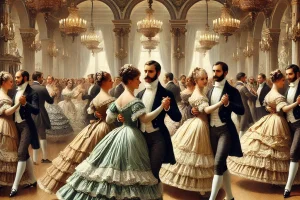
The danza was the evolutionary step between contradanza and danzón — a more intimate, more Cubanized couple's dance that dominated Havana's salons in the second half of the 19th century.
From Contradanza to Danza
Where the contradanza was still tied to its European group-figure format, the danza stripped this away and became purely a couple's dance. Two people, face to face, moving together — more physical contact, more sensuality, more rhythmic engagement.
The transformation happened gradually through the 1840s–1860s as Cuban composers simplified and condensed the contradanza form. The result was shorter, more danceable pieces that fit neatly into the salon setting but felt distinctly Cuban.
Musical Character
The danza retained the habanera rhythm of the contradanza but developed it further:
- Shorter, more concentrated form (often just two contrasting sections)
- More melodic expressiveness in the piano writing
- A cleaner rhythmic profile that made it easier to dance
- Growing influence of African syncopation in the bass and accompaniment patterns
Ignacio Cervantes
The towering figure of Cuban danza composition is Ignacio Cervantes (1847–1905). His piano danzas are considered masterworks of 19th-century Cuban music — technically sophisticated, melodically beautiful, and rhythmically alive. Cervantes studied at the Paris Conservatoire but returned to Cuba with a distinctly Cuban voice. His danzas bridge European classical technique with Afro-Cuban rhythmic sensibility.
His work is still performed in Cuban concert halls today as part of the classical repertoire.
Social Context
The danza was a salon form — it belonged to Havana's middle and upper class. But the rhythms it was built on came from the streets and the countryside. Every time a salon pianist played a syncopated danza bass pattern, they were unconsciously transmitting African musical memory into the parlors of Cuba's educated class.
This tension — African rhythmic content in European social form — runs through the entire history of Cuban music. The danza is one of the clearest early examples.
The Bridge to Danzón
By the 1870s, the danza had reached a saturation point. Audiences and musicians were ready for something more. In 1879, Miguel Faílde premiered "Las Alturas de Simpson" in Matanzas — the first danzón — and the danza began its gradual decline as the dominant salon form. But its harmonic language and rhythmic sensibility flowed directly into danzón and everything that followed.