History
Cuban music and dance did not evolve in a straight line — it grew in layers, with African, European, and Indigenous traditions colliding, merging, and transforming across four centuries. This page traces that evolution from the earliest colonial forms through to timba.
Cuban dance evolution: Salon vs Popular Settings
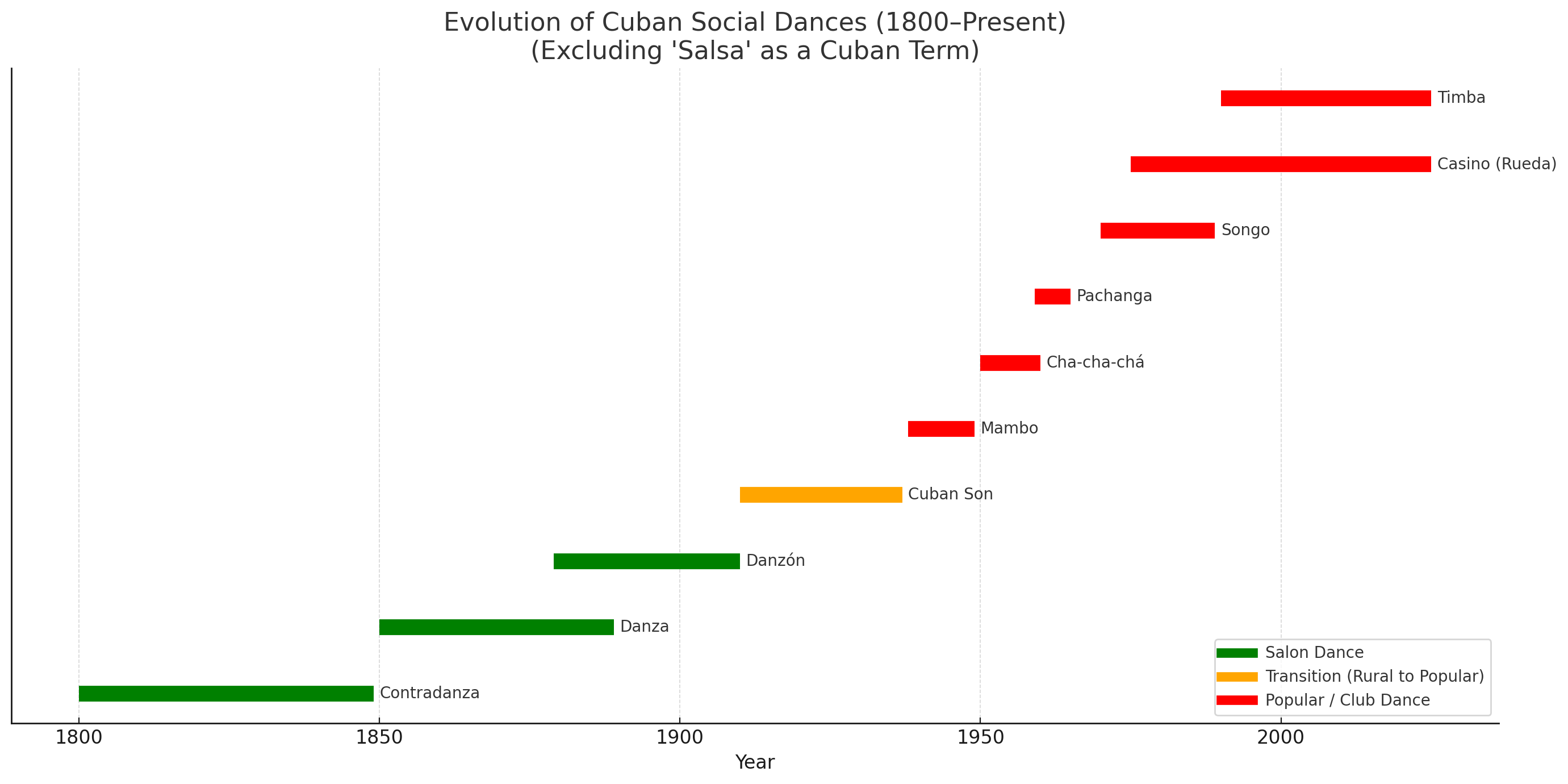
- Green = Salon dances (formal, indoors)
- Orange = Transitional (from rural or informal toward broader popularity)
- Red = Dance hall/club dances (popular, social settings)
The oldest surviving roots of Cuban popular music, from the mountains of eastern Cuba. Direct ancestors of son. Read more
Contradanza – Early 19th century (1800s)
The first European dance form to transform under African influence in Cuba — the seed of danzón, mambo, and the entire salon lineage. Read more
Bolero Cubano – 1880s
Cuba's great romantic song tradition — slow, intimate, and emotionally deep. Woven through every genre that followed. Read more
Danza – Mid to Late 19th century (1850–1890)
A more Cubanized evolution of contradanza — the couple's dance that bridged the salon world toward danzón. Read more
Rumba – 1880s–1900s
Born in the streets and courtyards of Havana and Matanzas — the most purely African-rooted form in Cuban popular music, ancestor of everything that followed. Read more
Danzón – Late 19th century (1879)
The first national dance of Cuba, born in Matanzas in 1879. Defined the charanga ensemble and the montuno concept. Read more
Guaracha – 19th century onward
Cuban popular music's great satirical tradition — fast, comic, and irreverent. Never dominant, never absent. Read more
Cuban Son – Late 19th to early 20th century
The most important genre in Cuban music history — the root from which mambo, salsa, and timba all grew. Read more
Mambo – Late 1930s to 1940s
Cuba's first global music explosion — the big band sound that conquered dance floors from Havana to New York to Tokyo. Read more
Born from the desire to make mambo accessible to all dancers. Still one of the most danced styles in the world. Read more
Casino – 1950s–1960s
The Cuban partner dance born in Havana's social clubs — circular, improvisational, and the direct ancestor of what the world calls salsa. Read more
Los Van Van's revolutionary synthesis of Cuban tradition, funk, rock, and jazz — the direct foundation for timba. Read more
Timba – 1980s–1990s
The music this site is dedicated to. Born in crisis, built on four centuries of Cuban musical history, still evolving. Read more
The Arc
From the colonial contradanza to modern timba is a journey of roughly 200 years. But the thread is continuous:
European dance forms arrive → absorb African rhythmic energy → creolize into new Cuban forms → each form reaches a saturation point → a new synthesis explodes out of it
Contradanza → Danza → Danzón → Son → Mambo/Cha-cha-chá → Songo → Timba
At each step, the African roots assert themselves more strongly. Timba is the most African-influenced of all Cuban popular genres — the one where the rumba, the batá drums, the Afro-Cuban sacred music tradition, and the street are most present and most proud.
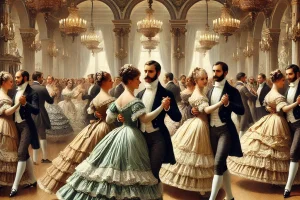
The contradanza was the first European-derived dance form to take root in Cuba and begin transforming under African influence. It is the starting point of the Cuban salon dance lineage that would eventually produce danzón, mambo, and cha-cha-chá.
Lees meer >The Cuban bolero is one of the great romantic song traditions of the world — slow, intimate, and deeply emotional. It is entirely distinct from the Spanish bolero (a fast 3/4 dance) and emerged in Cuba as a vehicle for the island's most heartfelt lyric expression.
Lees meer >The danza was the evolutionary step between contradanza and danzón — a more intimate, more Cubanized couple's dance that dominated Havana's salons in the second half of the 19th century.
Lees meer >Rumba is the most African-rooted of all Cuban music and dance forms — born in the streets, courtyards, and docks of Havana and Matanzas in the late 19th century, with no European instruments, no salon setting, and no pretense of European propriety.
Lees meer >Rumba is the most African-rooted of all Cuban music and dance forms — born in the streets, courtyards, and docks of Havana and Matanzas in the late 19th century, with no European instruments, no salon setting, and no pretense of European propriety.
Lees meer >Rumba is the most African-rooted of all Cuban music and dance forms — born in the streets, courtyards, and docks of Havana and Matanzas in the late 19th century, with no European instruments, no salon setting, and no pretense of European propriety.
Lees meer >The guaracha is Cuban popular music's great satirical tradition — fast, comedic, irreverent, and rhythmically playful. It has coexisted with every major Cuban genre since the 19th century, never dominant but never absent.
Lees meer >The cha-cha-chá was born from a simple observation: dancers were struggling to follow mambo. Its creator gave them a rhythm they could feel in their feet — and the result became one of the most danced music styles in history.
Lees meer >Casino is the Cuban partner dance born in the social clubs (casinos deportivos) of Havana in the 1950s. It is what Cubans call their own social dance — distinct from, and older than, what the rest of the world calls "salsa."
Lees meer >Songo is the direct bridge between traditional Cuban music and timba. Developed by Los Van Van in the early 1970s, it rewired Cuban popular music by absorbing funk, rock, and jazz into the Afro-Cuban rhythmic foundation — and laid every groundwork that timba would build on.
Lees meer >Songo is the direct bridge between traditional Cuban music and timba. Developed by Los Van Van in the early 1970s, it rewired Cuban popular music by absorbing funk, rock, and jazz into the Afro-Cuban rhythmic foundation — and laid every groundwork that timba would build on.
Lees meer > Timba is the music this site is dedicated to exploring. It emerged as a distinct genre in the late 1980s and crystallized in the early 1990s — born in a moment of social crisis, built on the full accumulated history of Cuban music, and still evolving today.
Lees meer >Son dance is the foundation of all Cuban popular partner dancing — smooth, intimate, grounded, and musical. Every Cuban dance style that followed ( mambo, casino, timba) builds on the body vocabulary and structure established by son.
Lees meer >Egungun is the Yoruba masquerade tradition honoring the collective ancestors — the Egun, the dead who remain present and active in the lives of the living. In Cuba, the Egungun tradition survived within the broader world of Santería (Regla de Ocha) and the related Arará and Abakuá communities, though in a form shaped by the specific conditions of the island.
Lees meer >A Cuban popular dance music genre that emerged in the 1980s–90s
- emerged in the 1980s–90s
- influenced by songo, rumba, funk, blues, jazz, pop, rock and Afro-Cuban rhythms.
- Known for complex rhythm shifts, aggressive bass lines, and high energy that push dancers to improvise.
Lees meer >Montuno
🛎️ 1. General Role of the Cowbell
The montuno is the call-and-response section near the end of a salsa or son tune, where everything opens up rhythmically.
- The cowbell pattern becomes steady and driving, often the “salsa bell” pattern:
(Hits on 1, the “&” of 2, 4, and the “&” of 4)
So:
🕐 Cowbell = timekeeper
🎹 Piano = syncopation
🎺 Horns/voices = call & response
- Literally “march down” — this section is calmer, often before the montuno.
- The cowbell is not usually played here.
Instead, you mostly hear congas, bongos, and timbales on softer instruments like the cáscara (timbale shell pattern).
- The rhythm is more subtle, leaving space for vocals or melodic content.
So:
In marcha abajo, the cowbell rests or plays lightly (if at all), and rhythmic emphasis is on cáscara or bongó martillo.
- “March up” — this means the groove intensifies.
- The cowbell comes in strong, providing the main pulse.
- The timbalero usually plays the large cowbell ( campana), while the bongocero might play the smaller bell for contrast.
- This section is about energy and drive — dance climax.
So:
In marcha arriba, the cowbell leads the rhythm section, locking in with the bass and clave to propel the music forward.
🧭 Summary Table
| Section |
Cowbell Player |
Function |
Typical Pattern |
Energy |
| Marcha abajo |
Usually silent or light (cáscara instead) |
Keeps groove subtle |
Cáscara on timbales |
Low–Medium |
| Montuno |
Bongocero (small bell) |
Keeps steady timeline for montuno section |
Salsa bell pattern |
Medium–High |
| Marcha arriba |
Timbalero (big bell) |
Drives rhythm, peak energy |
Salsa bell (louder, heavier) |
High |
Would you like me to add rhythmic notation (in 2–3 and 3–2 clave alignment) for each section’s cowbell pattern? That can make it easier to visualize how it fits with the rest of the rhythm section.
Son dance is the foundation of all Cuban popular partner dancing — smooth, intimate, grounded, and musical. Every Cuban dance style that followed (mambo, casino, timba) builds on the body vocabulary and structure established by son.
Lees meer >Montuno
The cowbell
🛎️ 1. General Role of the Cowbell
🎹 2. Montuno Section
The montuno is the call-and-response section near the end of a salsa or son tune, where everything opens up rhythmically.
- The cowbell pattern becomes steady and driving, often the “salsa bell” pattern:
(Hits on 1, the “&” of 2, 4, and the “&” of 4)
- The bongocero switches from hand drums to cowbell at this point.
- The cowbell keeps time over the clave and supports the montuno piano pattern, bass tumbao, and horn riffs.
So:
🕐 Cowbell = timekeeper
🎹 Piano = syncopation
🎺 Horns/voices = call & response
🔻 3. Marcha Abajo (Down Section)
- Literally “march down” — this section is calmer, often before the montuno.
- The cowbell is not usually played here.
Instead, you mostly hear congas, bongos, and timbales on softer instruments like the cáscara (timbale shell pattern).
- The rhythm is more subtle, leaving space for vocals or melodic content.
So:
In marcha abajo, the cowbell rests or plays lightly (if at all), and rhythmic emphasis is on cáscara or bongó martillo.
🔺 4. Marcha Arriba (Up Section)
- “March up” — this means the groove intensifies.
- The cowbell comes in strong, providing the main pulse.
- The timbalero usually plays the large cowbell (campana), while the bongocero might play the smaller bell for contrast.
- This section is about energy and drive — dance climax.
So:
In marcha arriba, the cowbell leads the rhythm section, locking in with the bass and clave to propel the music forward.
🧭 Summary Table
| Section |
Cowbell Player |
Function |
Typical Pattern |
Energy |
| Marcha abajo |
Usually silent or light (cáscara instead) |
Keeps groove subtle |
Cáscara on timbales |
Low–Medium |
| Montuno |
Bongocero (small bell) |
Keeps steady timeline for montuno section |
Salsa bell pattern |
Medium–High |
| Marcha arriba |
Timbalero (big bell) |
Drives rhythm, peak energy |
Salsa bell (louder, heavier) |
High |
Would you like me to add rhythmic notation (in 2–3 and 3–2 clave alignment) for each section’s cowbell pattern? That can make it easier to visualize how it fits with the rest of the rhythm section.
The terms "marcha abajo" and "marcha arriba" describe different energy levels or sections within the montuno.
Lees meer >The terms "marcha abajo" and "marcha arriba" describe different energy levels or sections within the montuno.
Lees meer >
The clave is a fundamental rhythmic pattern and organizing principle in Cuban music. It serves as both a musical pattern and a guiding concept, deeply rooted in Afro-Cuban traditions.
Lees meer >
The bongo is a pair of small open-bottomed drums played with fingers and palms. It originated in eastern Cuba and became one of the defining percussion voices of son and timba.
Lees meer >
The bongo is a pair of small open-bottomed drums played with fingers and palms. It originated in eastern Cuba and became one of the defining percussion voices of son and timba.
Lees meer >
The bongo is a pair of small open-bottomed drums played with fingers and palms. It originated in eastern Cuba and became one of the defining percussion voices of son and timba.
Lees meer >
How to Dance to the Campana (Cowbell)
In Cuban timba and songo, the campana (cowbell) is not just a rhythm — it is a communication system between the band and the dancers.
Lees meer >
How to Dance to the Campana (Cowbell)
In Cuban timba and songo, the campana (cowbell) is not just a rhythm — it is a communication system between the band and the dancers.
Lees meer > 
The conga (also called tumbadora) is the primary hand drum of Cuban music and the rhythmic backbone of timba, son, rumba, and salsa.
Lees meer >The timbales (pailas criollas) are a pair of shallow, metal-shell drums mounted on a stand, played with wooden sticks. They are the rhythmic engine of charanga orchestras and play a critical role in timba.
Lees meer >Timba, the explosive and rhythmically rich genre of Cuban dance music, transformed how the bass functions in popular music. In Timba, the bass is not just foundational — it’s fiery, funky, and free.
Lees meer >The piano is the harmonic and rhythmic heart of Cuban popular music. In timba, it is one of the most demanding and expressive instruments in the ensemble.
Lees meer >The piano is the harmonic and rhythmic heart of Cuban popular music. In timba, it is one of the most demanding and expressive instruments in the ensemble.
Lees meer >Mambo
In Cuban music, especially in salsa and son,
the "mambo" section typically refers to a brassy, rhythmically intense instrumental break,
often featuring repetitive horn lines, call-and-response patterns, and building energy toward the climax of a song.
Son dance is the foundation of all Cuban popular partner dancing — smooth, intimate, grounded, and musical. Every Cuban dance style that followed (mambo, casino, timba) builds on the body vocabulary and structure established by son.
Lees meer >The batá drums are a set of three double-headed hourglass-shaped drums central to Yoruba religious tradition and Afro-Cuban sacred music (Lucumí / Santería).
Lees meer >The piano is the harmonic and rhythmic heart of Cuban popular music. In timba, it is one of the most demanding and expressive instruments in the ensemble.
Lees meer > Cuba is the largest island in the Caribbean and the birthplace of some of the world's most influential music and dance traditions. African, Spanish, and French cultural streams collided here over centuries of colonial history, producing an extraordinary creative culture that exported itself across the globe.
Lees meer >The following dances have their origin in Matanzas: