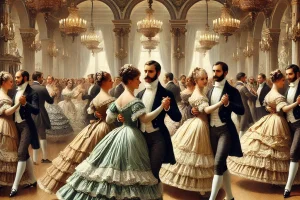
Danza - dance
Danza is the evolutionary step between contradanza and danzón — Cuba's first true couple's dance, more intimate and more African in character than the European formations it replaced.
Origins
The Danza developed through the 1840s–1870s as Cuban composers simplified the contradanza into shorter, more intimate pieces designed specifically for two people dancing together. It was the dominant salon form in Havana and Matanzas before danzón took over in 1879.
Dance Character
Danza was a significant departure from contradanza:
- Pure couple's dance — no group formations, no caller; just two people
- Closer embrace — more physical contact than contradanza allowed
- Hip movement beginning — the body started engaging more fully with the syncopated rhythm, hips moving as a natural consequence of the musical pulse
- Sensual quality — by contradanza standards, danza was considered provocative; it pushed the boundary of what was socially acceptable in the salon
This was the habanera rhythm asserting itself more strongly through the body of the dancer.
Musical Connection
The danza had two sections — an introductory A section and a more rhythmically active B section — that the couple danced through continuously without stopping. This was the predecessor of danzón's more elaborate multi-section structure.
Compositionally, the piano danzas of Ignacio Cervantes are considered masterworks — technically sophisticated pieces that blend European classical technique with Cuban rhythmic life.
Today
Like the contradanza, the danza is primarily of historical interest today — it is not danced socially. It appears in musicological research, concert performances of Cervantes' piano danzas, and folk cultural contexts. Its living legacy is in everything that came after it: danzón, son, and the entire Cuban dance lineage.