Güiro - instrument
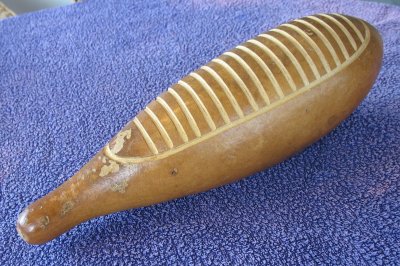
The güiro is a notched gourd scraped with a stick or fork to produce a rasping, rhythmic sound. It is a standard feature of charanga orchestras and is central to danzón, cha-cha-chá, son, and salsa.
https://en.wikipedia.org/wiki/Güiro
Origins
The güiro is derived from Indigenous Taíno gourd instruments pre-dating European contact. Scraped percussion of this kind was common across the Caribbean. In Cuba it became absorbed into the mestizo musical tradition.
Construction
A dried, hollowed gourd with notches cut into its surface. Played by dragging a thin wooden or metal stick across the notches in long (slow) or short (quick) strokes. The combination of long and short scrapes creates the characteristic syncopated rhythm.
The güiro is the signature percussion instrument of the charanga francesa ensemble — the orchestra format that defined danzón, danzonete, cha-cha-chá, and early Cuban popular dance music. Alongside flute, violins, piano, bass, and timbales, the güiro provides constant rhythmic texture.
In a charanga band the güiro player keeps strict time, and the pattern they play helps define what dance style is being played. The cha-cha-chá güiro pattern, for instance, is instantly recognizable.
The güiro is not commonly used in modern timba bands (which rely on congas, timbales, and bongo/campana), but it appears in recordings and arrangements that reference the charanga or son traditions. Its role has been largely absorbed into the overall percussion texture of contemporary Cuban music.
The cha-cha-chá was born from a simple observation: dancers were struggling to follow mambo. Its creator gave them a rhythm they could feel in their feet — and the result became one of the most danced music styles in history.
Lees meer > Timba is the music this site is dedicated to exploring. It emerged as a distinct genre in the late 1980s and crystallized in the early 1990s — born in a moment of social crisis, built on the full accumulated history of Cuban music, and still evolving today.
Lees meer >Son dance is the foundation of all Cuban popular partner dancing — smooth, intimate, grounded, and musical. Every Cuban dance style that followed ( mambo, casino, timba) builds on the body vocabulary and structure established by son.
Lees meer >Danzonete is the sung evolution of danzón — the bridge between the purely instrumental danzón of the 19th and early 20th century and the vocal popular music that would follow.
Lees meer >A Cuban popular dance music genre that emerged in the 1980s–90s
- emerged in the 1980s–90s
- influenced by songo, rumba, funk, blues, jazz, pop, rock and Afro-Cuban rhythms.
- Known for complex rhythm shifts, aggressive bass lines, and high energy that push dancers to improvise.
Lees meer >Cuban music is built on percussion. The extraordinary density and variety of Cuban rhythmic culture reflects the meeting of West and Central African drumming traditions with Spanish, Haitian, and creole musical practices over four centuries. The instruments below form the core percussive vocabulary heard across Son, Rumba, Timba, Danzón, and their descendants.
Lees meer >
The bongo is a pair of small open-bottomed drums played with fingers and palms. It originated in eastern Cuba and became one of the defining percussion voices of son and timba.
Lees meer >The timbales ( pailas criollas) are a pair of shallow, metal-shell drums mounted on a stand, played with wooden sticks. They are the rhythmic engine of charanga orchestras and play a critical role in timba.
Lees meer > Timba, the explosive and rhythmically rich genre of Cuban dance music, transformed how the bass functions in popular music. In Timba, the bass is not just foundational — it’s fiery, funky, and free.
Lees meer >The piano is the harmonic and rhythmic heart of Cuban popular music. In timba, it is one of the most demanding and expressive instruments in the ensemble.
Lees meer > Cuba is the largest island in the Caribbean and the birthplace of some of the world's most influential music and dance traditions. African, Spanish, and French cultural streams collided here over centuries of colonial history, producing an extraordinary creative culture that exported itself across the globe.
Lees meer >The Caribbean region was a crossroads of African, European, and indigenous cultures during the colonial era. The movement of enslaved people and colonizers between islands created musical and dance traditions that spread across the region and deeply influenced Cuban culture.
Lees meer >