Güiro - instrument
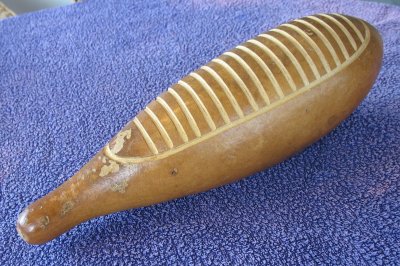
De güiro is een getande kalebas die met een stokje of vork wordt bestreken om een raspend, ritmisch geluid te produceren. Het is een vast onderdeel van charanga-orkesten en staat centraal in danzón, cha-cha-chá, son en salsa.
https://en.wikipedia.org/wiki/Güiro
Oorsprong
De güiro is afgeleid van de Inheemse Taíno-kalebasinstrumenten die al vóór het Europese contact bestonden. Krasslaginstrumenten van dit type waren wijdverspreid in het Caribisch gebied. In Cuba werd het opgenomen in de mestiezen muziektraditie.
Constructie
Een gedroogde, uitgeholle kalebas met inkepingen in het oppervlak. Bespeeld door een dun houten of metalen stokje over de inkepingen te trekken met lange (langzame) of korte (snelle) streken. De combinatie van lange en korte schraapbewegingen creëert het kenmerkende gesyncopeerde ritme.
De güiro is het kenmerkende slaginstrument van het charanga francesa-ensemble — het orkestformaat dat danzón, danzonete, cha-cha-chá en de vroege Cubaanse populaire dansmuziek definieerde. Naast fluit, violen, piano, bas en timbales zorgt de güiro voor een constante ritmische textuur.
In een charanga-band houdt de güiro-speler strak de maat, en het patroon dat hij speelt helpt bepalen welke dansstijl wordt gespeeld. Het cha-cha-chá güiro-patroon is bijvoorbeeld onmiddellijk herkenbaar.
De güiro wordt niet vaak gebruikt in moderne timba-bands (die vertrouwen op congas, timbales en bongo/campana), maar het verschijnt in opnames en arrangementen die verwijzen naar de charanga- of son-tradities. De rol is grotendeels opgegaan in de algehele percussietextuur van de hedendaagse Cubaanse muziek.
Danzón was de eerste nationale dans van Cuba — de vorm die in de late 19e en vroege 20e eeuw de identiteit van de Cubaanse populaire muziek verenigde, en de voorloper van mambo, cha-cha-chá en uiteindelijk timba.
Lees meer >Danzón was de eerste nationale dans van Cuba — de vorm die in de late 19e en vroege 20e eeuw de identiteit van de Cubaanse populaire muziek verenigde, en de voorloper van mambo, cha-cha-chá en uiteindelijk timba.
Lees meer >De cha-cha-chá werd geboren uit een eenvoudige observatie: dansers hadden moeite om mambo te volgen. De bedenker gaf hen een ritme dat ze in hun voeten konden voelen — en het resultaat werd een van de meest gedanste muziekstijlen in de geschiedenis.
Lees meer > Timba is the music this site is dedicated to exploring. It emerged as a distinct genre in the late 1980s and crystallized in the early 1990s — born in a moment of social crisis, built on the full accumulated history of Cuban music, and still evolving today.
Lees meer >De son-dans is de basis van alle Cubaanse populaire partnerdansen — vloeiend, intiem, geaard en muzikaal. Elke Cubaanse dansstijl die volgde ( mambo, casino, timba) bouwt voort op het lichaamsvocabulaire en de structuur die door de son is vastgelegd.
Lees meer >Danzonete is de gezongen evolutie van danzón — de brug tussen de puur instrumentale danzón van de 19e en vroege 20e eeuw en de vocale populaire muziek die zou volgen.
Lees meer >Een Cubaans populair dansmuziekgenre dat ontstond in de jaren 1980–90
- Ontstaan in de jaren 1980–90
- Beïnvloed door songo, rumba, funk, blues, jazz, pop, rock en Afro-Cubaanse ritmes.
- Bekend om complexe ritmewisselingen, agressieve baslijnen en hoge energie die dansers aanzet tot improvisatie.
Lees meer >
De bongo is een paar kleine, open trommels die met vingers en handpalmen worden bespeeld. Het instrument is afkomstig uit het oosten van Cuba en werd een van de bepalende percussiestemmen van son en timba.
Lees meer >De timbales ( pailas criollas) zijn een paar ondiepe trommels met metalen behuizing, op een standaard gemonteerd en bespeeld met houten stokken. Ze zijn de ritmische motor van charanga-orkesten en spelen een cruciale rol in timba.
Lees meer >De piano is het harmonisch en ritmisch hart van de Cubaanse populaire muziek. In timba is het een van de meest veeleisende en expressieve instrumenten van het ensemble.
Lees meer > Cuba is the largest island in the Caribbean and the birthplace of some of the world's most influential music and dance traditions. African, Spanish, and French cultural streams collided here over centuries of colonial history, producing an extraordinary creative culture that exported itself across the globe.
Lees meer >